- English
- Español
- Português
- русский
- Français
- 日本語
- Deutsch
- Italiano
- Nederlands
- 한국어
- Svenska
- Dansk
- Suomi
- Gaeilge
- Indonesia
- Norsk
- český
- український
- Қазақша
- Euskal
- Srpski језик
- tiếng Việt
- ภาษาไทย
- Polski
- magyar
- Malay
- বাংলা ভাষার
- हिन्दी
- Pilipino
- Türkçe
- العربية
- تمل
- ελληνικά
- Javanese
- فارسی
- தமிழ்
- తెలుగు
- नेपाली
- Burmese
- български
- ລາວ
- Latine
- Azərbaycan
- Slovenský jazyk
- Македонски
- Lietuvos
- Eesti Keel
- Română
- Slovenski
- मराठी

Epoxy Resin Foam Core vs. PMI Foam Core: Carbon Fiber Ice Hockey Stick Blade Comparison
For ice hockey players, every slap shot, precision pass, and puck control move relies on the hidden performance of your stick blade. Beneath the carbon fiber outer layer, the internal core material is the foundational component that defines a blade’s weight, stiffness, feel, and long-term durability. Two dominant core technologies power today’s carbon fiber ice hockey sticks: epoxy resin foam core and PMI (polymethacrylimide) foam core.
Whether you are upgrading your game controller, purchasing team equipment, or comparing product specifications, understanding the differences between these two core materials will help you make a confident and performance-oriented choice. In this guide, we will thoroughly compare the two to assist you in selecting the appropriate blade core material based on your playing style, technical level, and budget.
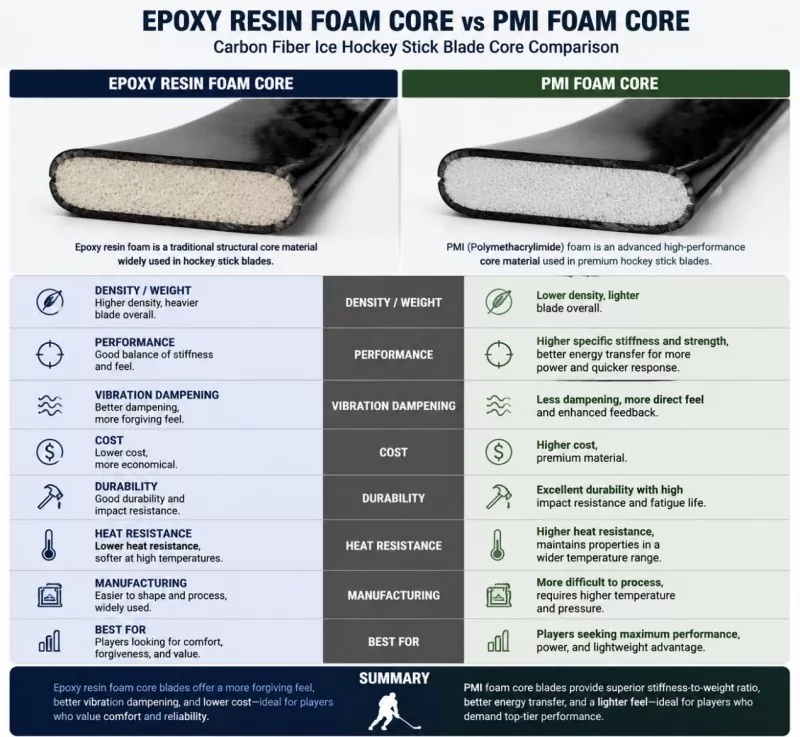
What is Epoxy Resin Foam Core?
Epoxy resin foam is a longstanding traditional structural core material, widely adopted across the ice hockey industry for decades. As a proven, cost-effective core solution, it delivers a balanced set of performance characteristics that cater to a broad spectrum of players.
Built with an epoxy-based foam internal structure, this core delivers reliable foundational stiffness and consistent impact resistance at an accessible price point. It remains a staple in mid-range and value-focused carbon fiber hockey stick lines, prioritizing all-day comfort and dependable on-ice usability.
What is PMI Foam Core?
PMI (polymethyl methacrylate) foam is an advanced and high-performance core material specifically designed for high-end and professional-grade ice hockey stick blades. This high-end structural foam has been meticulously engineered and possesses outstanding mechanical properties, setting the benchmark standard for stiffness-to-weight ratio in the industry.
Recognized globally for its ultra-lightweight composition and exceptional tensile strength, PMI foam is the preferred choice for competitive and elite players who demand maximum power, speed, and feedback from their stick. It is the signature core technology in top-tier carbon fiber hockey stick lines built for high-intensity league and professional play.
Side-by-Side Performance Comparison
We compare epoxy resin foam core and PMI foam core across 7 critical factors that define real-world on-ice performance:
1. Density & Weight
● Epoxy Resin Foam Core: Features a higher material density, resulting in an overall heavier blade. The added mass creates a stable, solid feel during shooting but may reduce maximum swing speed for players prioritizing quick handling.
● PMI Foam Core: Boasts significantly lower density for a dramatically lighter blade construction. Reduced blade weight translates to faster swing speeds, quicker stick handling maneuvers, and less muscle fatigue over full game play.
2. Core Performance & Energy Transfer
● Epoxy Resin Foam Core: Delivers a well-rounded balance of stiffness and feel, providing consistent, reliable performance for casual and intermediate players. It delivers steady shot power without maximizing energy transfer efficiency.
● PMI Foam Core: Delivers industry-leading specific stiffness and strength, enabling far more efficient energy transfer on every shot. This means greater power behind slap shots and wrist shots, paired with a snappier, more responsive feel for fast, reactive puck control.
3. Vibration Dampening & On-Ice Feel
● Epoxy Resin Foam Core: Offers superior vibration dampening for a more forgiving feel on off-center hits. It softens the sting of mis-hits and reduces hand & arm fatigue, making it ideal for players who prioritize comfort during long training sessions and games.
● PMI Foam Core: Features less dampening for a more direct, tactile feel and enhanced puck feedback. Players get clearer sensory response from every puck contact, supporting more precise shot placement and tighter control.
4. Cost & Overall Value
● Epoxy Resin Foam Core: Lower material and production costs make it the more economical option. It delivers solid, dependable performance at a budget-friendly price point, offering exceptional value for recreational players and entry-level competitors.
● PMI Foam Core: Classified as a premium, high-cost material. Its advanced material properties and specialized manufacturing requirements drive a higher price point, positioning it as a performance investment for serious, skill-focused players.
5. Durability & Impact Resistance
● Epoxy Resin Foam Core: Provides good durability and solid impact resistance, holding up reliably for regular recreational and league-level play.
● PMI Foam Core: Delivers excellent long-term durability, with high impact resistance and an extended fatigue life. It retains its structural integrity even after repeated high-force impacts, making it more resilient for frequent, high-intensity use.
6. Heat Resistance
● Epoxy Resin Foam Core: Has lower heat resistance, and can soften when exposed to elevated temperatures. Extreme heat may gradually impact blade rigidity and structural performance over time.
● PMI Foam Core: Features significantly higher heat resistance, maintaining its mechanical properties across a much wider temperature range. It remains stable in varying environments, from cold ice rinks to warm storage and transport conditions.
7. Manufacturing Process
● Epoxy Resin Foam Core: Easy to shape, mold, and process, making it widely accessible across hockey equipment manufacturers. Its straightforward molding requirements support consistent mass production and reliable quality control.
● PMI Foam Core: More complex and difficult to process, requiring higher temperature and pressure during the manufacturing cycle. This specialized production process contributes to its premium cost, but is critical to achieving its high-performance structural properties.
Which Blade Core is Right for You?
Your ideal core material depends on your skill level, on-ice priorities, and budget:
● Choose Epoxy Resin Foam Core if: You are a recreational, beginner, or intermediate player who values a forgiving feel, reliable comfort, and strong overall value. It is also a smart choice for players seeking a durable, low-maintenance stick for regular league play.
● Choose PMI Foam Core if: You are a competitive, advanced, or elite player seeking maximum performance, lightweight advantage, and peak power output. If direct puck feedback, fast energy transfer, and premium long-term durability are your top priorities, PMI foam is the superior option.
Final Summary
Epoxy resin foam core boards remain the preferred choice for most players, being accessible and reliable. They offer generous performance, excellent shock absorption, and affordable prices. However, for those players who are unwilling to compromise on their ice performance, PMI foam core boards stand out with their unparalleled rigidity-to-weight ratio, sensitive energy transfer, and top-notch durability.
No matter your skill level or playing style, selecting the right core material will align your stick’s performance with your needs and help you elevate your game.
Shop Premium Carbon Fiber Hockey Sticks at GY Hockey
At GY Hockey, we engineer and manufacture professional-grade carbon fiber ice hockey equipment built for real-world performance. Our full stick lineup includes both epoxy resin foam core and premium PMI foam core blade options, so you can find the perfect match for your playing style and budget.
Explore our complete collection of ice hockey sticks, protective gear, and performance accessories today at www.gyhockey.com to gear up with equipment that delivers results on the ice.